Reading a Building Entrance on a Rainy Day
Reading a building entrance on a rainy day reveals how its canopy, paving, sightlines, and threshold guide arrival while sheltering people from the weather.
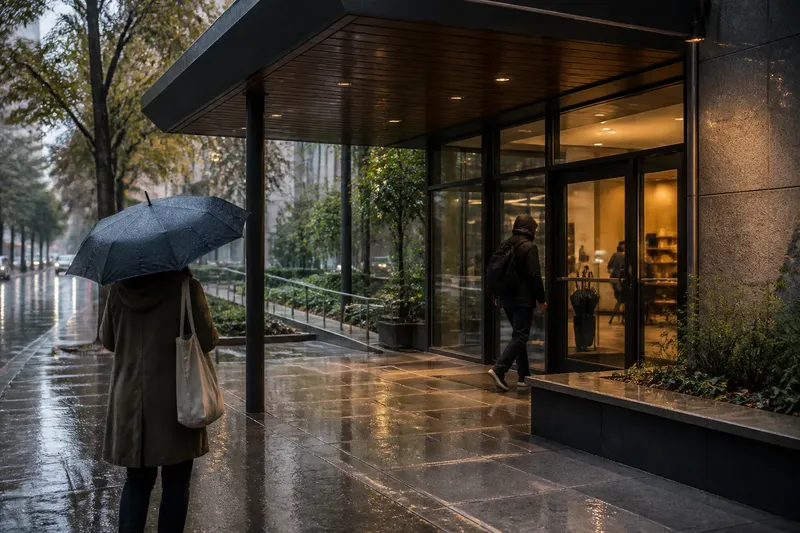
Reading a building entrance on a rainy day begins with the first place the building lets you stop. Watch where people pause with wet coats, umbrellas, or bags, and notice whether that spot is sheltered without blocking the route inside. Rain makes the entrance’s decisions unusually visible: the canopy has to meet the wall, paving has to carry water away, and the doorway has to remain legible through reflections and movement.
Begin where the sidewalk meets the building
Approach from the public sidewalk rather than starting at the door. A projecting canopy may offer shelter before a visitor reaches the building, while a shallow overhang can protect only the threshold. Look at where its edge falls in relation to the curb, steps, ramp, and any place someone might wait.
Pay attention to the ground beneath that cover. A change from sidewalk concrete to stone, brick, or textured tile can mark a route, but a polished surface may become harder to read when it holds reflections. Notice whether water runs across the likely walking line or gathers near the entrance.
Follow the visible route with your eyes before walking it. A direct path can feel welcoming, but a low planter, door swing, or queue rail may complicate the approach. The useful question is not whether the entrance looks grand; it is whether a newcomer can tell where to go without stopping in the rain.
On a walk, note the first sheltered place where a person could pause without obstructing others.
Read the canopy as a small public shelter
A canopy does more than keep rain off the door. Its depth, supports, and edge shape determine whether it shelters someone approaching, someone waiting, or only the door itself. Compare the protected ground with the exposed route that leads to it.
Look up at the underside and then toward the building wall. Downspouts, seams, and joints can show where runoff is directed; a drip line that lands on the entry path may undo the shelter the canopy appears to provide. A canopy’s structure also affects visibility: a heavy fascia can obscure signage, while thin supports may leave the entrance easier to see from the sidewalk.
Observe how the sheltered area is shared. If the canopy covers a bench, a delivery drop-off, or a group waiting for someone, ask whether the doorway still has clear space. An entrance can offer generous cover yet feel cramped when every use converges at the same point.
Track the canopy’s outer edge in relation to the path, not just the door.
Notice how water changes the ground
Rain gives paving a second appearance. Dry, subtle joints can become dark lines; stone may reveal a slope through the direction of moving water; and a shallow puddle can make a small dip unmistakable. These observations are about how the route behaves, not a judgment of whether a surface is safe.
Where does water cross the approach, and where does it settle? Check the paving near door mats, at the bottom of ramps, beside planting beds, and around drainage grates. The location of a grate can tell you whether runoff is being intercepted before it reaches the threshold or simply collected nearby.
Changes in texture can help distinguish the entrance route from adjacent pavement, especially when rain blurs color differences. But a material shift is only useful if it reads consistently: a narrow strip might mark a doorway, a drain, or a repair. Follow it in both directions to see whether its purpose becomes clear.
Look for the path water takes, then compare it with the path people take.
Check what a newcomer can see from outside
Glass doors and sidelights make an entrance visible, but rain complicates the view. Reflections of traffic, trees, and bright pavement can compete with the interior, while condensation or a dark vestibule can conceal the next move. Stand to one side of the approach and ask whether the door, handle, and route beyond remain distinguishable.
Look for signs at the moment they are needed. A building name may be clear from across the street but an entrance instruction can disappear beneath the canopy or behind a door leaf. Notice whether a visitor can see where to enter, where to wait, and whether the doorway opens toward or away from the approaching path.
Imagine arriving at a neighborhood library in steady rain with a tote bag and no familiarity with the building. The canopy covers the door but not the sign, and a reflection hides the lobby; moving the directional sign to the sheltered side of the glass would make the next action easier to spot before the visitor reaches the threshold.
Stand where a first-time visitor would stand, rather than where the sign is easiest to photograph.
Follow the shift from street to interior
The threshold is a sequence, not merely a line in the wall. A mat, recessed doorway, vestibule, or change in light can signal that the public street is giving way to a more controlled interior. Notice how many transitions occur before someone reaches the main room, and whether each one is apparent.
A vestibule can buffer wind and rain, but its doors may create a brief bottleneck if people entering and leaving meet in a tight space. Watch the direction of movement and whether someone can step aside to shake an umbrella or let another person pass. The detail of where wet umbrellas are expected to go also matters: a stand or drip tray placed outside the main route keeps the threshold from becoming an obstacle course.
Lighting helps make this transition readable. A bright exterior against a dim lobby can turn clear glazing into a mirror; a lit vestibule may reveal the next door and the space beyond. Notice how the floor, ceiling, and view change together, rather than treating the doorway as an isolated object.
Look for a place to pause that does not interrupt the flow through the threshold.
What should you look for at a rainy entrance?
Where does the canopy’s shelter begin?
Find the point where a person first leaves the rain, then compare it with the approach route and any likely waiting spot. This shows whether shelter supports arrival or only covers the doorway.
Where does runoff cross the walking path?
Trace visible water from the canopy, paving, and nearby planting toward drains or low points. Notice whether it crosses the route, collects at a transition, or moves away from the entrance.
Can you identify the entrance through reflections?
View the door from the sidewalk and from the sheltered approach, checking whether signs, door edges, and the lobby remain visible. Reflections may make a glass entrance appear closed or conceal the route inside.
Where can someone pause without blocking others?
Look for space to wait, fold an umbrella, or let another person pass. A useful pause point is sheltered and visible without occupying the door’s swing or the main walking line.
Keep the observation focused
A short field note can record four things: the approach, the cover, the water’s route, and the first interior view. Add one sketch showing the canopy edge and the likely path people take; arrows can distinguish movement from runoff without turning the visit into a technical inspection.
Compare the entrance at two moments if the weather allows: during steady rain and after it eases. Wet paving may reveal slopes and puddling, while a lull can make it easier to see how people use the sheltered space. Avoid inferring hidden drainage or construction details from surface clues alone; where a design decision depends on building rules or manufacturer guidance, those sources determine the answer.
Reading a building entrance on a rainy day is most useful when attention stays with the visitor’s changing position: exposed sidewalk, sheltered approach, visible door, and interior beyond. Record one point where the route becomes clearer and one where it becomes harder to read. That small comparison can make a familiar doorway newly specific.